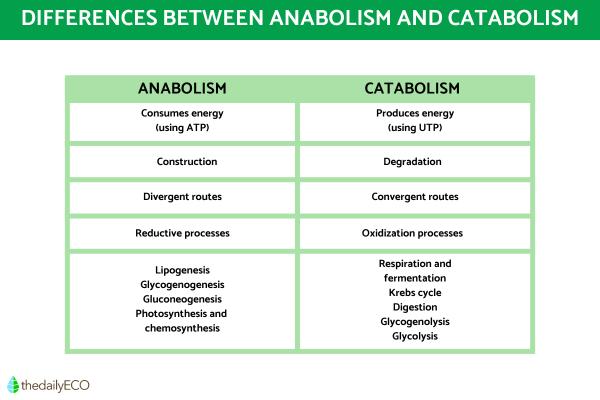
We often speak of our metabolism in very broad terms, especially in terms of our ability to gain or lose weight. In actuality, metabolism is a set of very precise processes which occur in all living organisms. This is true from the largest mammal to the smallest unicellular organism. Metabolism is the set of redox (oxidation-reduction) reactions. They occur through the regulation of various nutrients to perform various functions in the organism. These include stabilizing body temperature, creating energy production and maintaining other vital functions. These chemical reactions take place in the cells and are channeled enzymatically. They are organized into pathways which can be either catabolic or anabolic.
At thedailyECO, we help to better understand the metabolism of living organisms by looking at the differences between anabolism and catabolism. By understanding catabolic and anabolic reactions, we can have a better idea of how we remain alive.
What is anabolism?
Also known as biosynthesis, anabolism is the constructive phase of metabolic processes. It consists of the generation of complex organic molecules such as carbohydrates, lipids, fats, proteins, or nucleic acids from more simple molecules. It is for this reason, the functions of metabolism are associated with maintenance of an organism via repair, tissue growth, energy storage, and more.
Among the characteristics of anabolic reactions, we can find that:
- Anabolic pathways are routes that collect the chemical reactions of this process and are also known as divergent routes.
- These synthesis reactions are generally endergonic and reductive. Endergonic reactions are those where the molecules or ions gain electrons (i.e., they are positive), but they require a source of energy to do so. This source is normally adenosine triphosphate (ATP) which comes from catabolic phases.
- In anabolic reactions, the energy is consumed by the organism.
- The process is similar in all cells, providing a fundamental basis for life across species.
- Anabolism can be autotrophic in nature (as in the case of photosynthesis or chemosynthesis) or heterotrophic (as in the case of carbohydrates in gluconeogenesis and in glycogenogenesis, with lipids and proteins). Both types differ in the origin of the simple precursor molecules (amino acids, monosaccharides, nucleotides). If these molecules are formed from organic matter from other living beings, we speak of heterotrophic anabolism. If they are synthesized from their own organic matter and energy sources, the biosynthesis process is autotrophic anabolism.
- Hormones such as estrogen, insulin, growth hormone, and testosterone are involved in anabolic reactions, playing crucial roles in regulating energy levels and storage.
As with any biological process, it is possible to identify different phases. Specifically, there are 3 stages of anabolism:
- The generation of precursors takes place, some of which may be derived from the last phase of catabolism.
- These precursors are then activated by ATP molecules.
- Finally, the formation of complex molecules takes place, leading to the creation of essential cellular components.
As we have explained, anabolic reactions occur on a cellular level. See how this is facilitated with our article on the difference between plant and animals cells.
Examples of anabolism in biology
Now the concept of anabolism has been introduced, you may be able to use the characteristics of anabolic reactions to think of examples in biology. For example, you may be able to tell whether photosynthesis is an anabolic or catabolic reaction. Below, we briefly explain some of the most common examples of anabolic reactions:
Lipogenesis
It is the process by which the excess energy that we incorporate through the diet is used by the body. Specifically, it occurs in the metabolic process of converting the molecule acetyl-CoA into triglyceride fatty acids to be stored in fat. This process is vital for maintaining energy reserves and ensuring the body has sufficient resources during periods of fasting or increased energy demand.
Glycogenogenesis
This is the production of glycogen from glucose-6-phosphate and takes place in the liver and muscles. This process is similar to amylogenesis in plants (starch formation). The difference is that the energy source or activating molecule is uridine triphosphate (UTP) and not ATP. Glycogen serves as a crucial energy reserve, especially during high-intensity activities.
Gluconeogenesis
Gluconeogenesis or neoglucogenesis is the process of glucose synthesis, starting from precursors that are not carbohydrates. They can be converted to pyruvate or oxaloacetate, e.g., lactate, glycerol, or various amino acids. It takes place mainly in the liver (90%) and kidney (10%), which helps the brain and muscles to obtain the glucose necessary to cover their energy needs, particularly when dietary carbohydrates are scarce.
Photosynthesis and chemosynthesis
As hinted at earlier, photosynthesis is an autotrophic anabolism. This is the same as chemosynthesis, a similar chemical conversion which converts carbon-containing molecules into organic matter. The difference between photosynthesis and chemosynthesis is that the necessary energy is obtained from sunlight in the former, whereas chemosynthesis uses oxidization or ferrous compounds as energy sources. These processes are fundamental to life on earth, supporting the vast majority of ecosystems.
Learn more about this anabolic reaction with our article on types of chlorophyll and their function.

What is catabolism?
In contrast to anabolism, catabolic reactions are a form of destructive metabolism. They consist of the transformation or degradation of large organic molecules (e.g., carbohydrates, fats, or proteins) into smaller ones (e.g., lactic acid, CO2, or NH3). One of the main functions of catabolism is the degradation of organic nutrients in order to obtain chemical energy from them. This energy is then utilized for various cellular activities and repair processes.
Some of the main features of catabolic reactions include:
- The metabolic pathways or pathways are convergent, meaning they start from many different substrates. At the end of the process only a few products remain, which are often simpler and more easily utilized by the cell.
- The reactions that it comprises are of an oxidative and exergonic nature. This means the molecules or ions involved lose electrons (i.e., they are negative) and the release of energy takes place. This energy is then harnessed for various cellular functions.
- Adrenaline, cortisol, cytokines, or glucagon are examples of catabolic hormones, which play significant roles in regulating metabolic pathways, especially during stress responses.
As in anabolism, we can identify 3 stages of catabolism:
- The breakdown of large, complex organic molecules into amino acids, monosaccharides, and fatty acids takes place, allowing for easier absorption and utilization by the body.
- The products of the first phase are then transported to the cells in order to achieve further degradation and therefore obtain simpler molecules. During this process, energy is released, which is critical for sustaining life functions.
- Finally, the oxidation of the coenzymes that participate in the electron transport chain occurs, contributing to the formation of ATP, which is the primary energy currency of the cell.
Examples of catabolism in biology
As with anabolic reactions, it is helpful to look at examples of catabolic reactions to better understand the process:
Respiration and fermentation
Respiration and fermentation are two important and widely known catabolic processes. Despite both consisting of obtaining energy from complex organic molecules and sharing a first phase of glycolysis, they are significantly different.
Among other factors, they differ in the presence/absence of oxygen in the final electron acceptor. This is the case as fermentation is anaerobic as opposed to respiration which is aerobic. With fermentation, the final electron acceptor is an organic compound while respiration results in inorganic substances. Above all, fermentation does not achieve a complete breakdown of glucose, while respiration does, making it a more efficient energy-releasing process.
Krebs cycle
The citric acid cycle (CAC) or Krebs cycle is another catabolic process which configures one of the 4 stages of cellular respiration. It consists of the oxidation of carbohydrates, fatty acids, and amino acids until CO2 is obtained as the final product. This cycle plays a crucial role in energy production and provides intermediates for various other metabolic processes.
Digestion
We may be most familiar with this catabolic process which involves the breakdown of organic nutrients that we ingest through the diet. They are turned into simpler components that are easier for the body to use to satisfy food and energy needs. This process is essential for providing the necessary nutrients for cellular repair and growth.
Glycogenolysis
As indicated by the suffix -lysis (dissolution, breakdown), glycogenolysis is the metabolic pathway for the breakdown of glycogen, from which glucose is obtained. In this process, the most important enzyme involved is glycogen phosphorylase. This process is vital for maintaining blood sugar levels during periods of fasting or intense physical activity.
Glycolysis
This is the set of chemical reactions that, as part of the digestion process, allows the degradation of glucose. The resulting final products obtained depend on the presence or absence of oxygen, being pyruvate or lactate, respectively. Glycolysis is the first step in cellular respiration and is crucial for energy production.

What is the difference between anabolism and catabolism?
The main difference between anabolism and catabolism is understood by looking at them as two parts of a larger function. For a balanced metabolism to occur, both anabolic and catabolic reactions are required. They necessarily oppose each other and, in doing so, complement each other. In very basic terms, catabolic reactions degrade larger molecules to create simpler ones, and anabolic reactions use simple molecules to make more complex ones.
With the importance of these metabolic reactions on the growth of living beings, it is interesting to mention that organisms develop when anabolism exceeds catabolism. This according to Ludwig von Bertalanffy and his Growth Model, which is widely used in marine studies to estimate the relationship between age and the size of fish. Understanding this balance is crucial for advancements in fields such as agriculture, medicine, and ecology, where growth and energy management are key factors.
If you want to read similar articles to The Difference Between Anabolism and Catabolism, we recommend you visit our Biology category.
- Gluconeogenesis. Retrieved from: https://www.uv.es/marcof/Tema17.pdf
- catabolism. IB MONFORTE . BIOLOGY 2nd BAC. Retrieved from: https://www.edu.xunta.gal/centros/iesriocabe/system/files/u1/T_203_Catabolismo.pdf