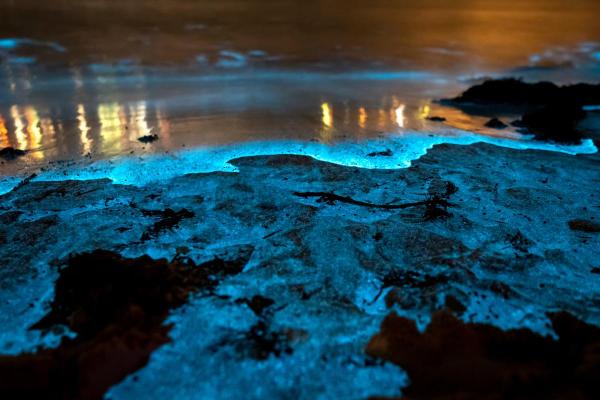
Bioluminescent beaches are coastal areas where living beings produce light as the waves meet the sand. This light emission is known as bioluminescence and is caused by a chemiluminescent reaction. Although some beaches are known for their bioluminescence, it is important to know that this does not happen all the time. The phenomenon normally occurs on warm summer nights when it is dark enough for the light to be seen. In this thedailyECO article, we ask what are bioluminescent beaches? We look at why they glow and where some of the most magical bioluminescent beaches in the world are.
What are bioluminescent beaches?
Beaches are landforms located on the coast where loose particles of various types of material meet the waves. Bioluminescent beaches are those that display emissions of light from living organisms located within these waves, a relatively uncommon phenomenon in nature. Bioluminescence is produced through a biochemical process in which marine organisms emit light. Some examples of such organisms include:
- Bacteria
- Dinoflagellates
- Radiolarians
- Ctenophores
- Cnidarians
- Annelids
- Mollusks
- Echinoderms
- Tunicates
- Fish
How this ability to produce light works is a true wonder of nature. These organisms are capable of producing light thanks to a very rapid chemiluminescent reaction. The light-emitting reaction involves a molecule (luciferin) that is oxidized by the action of a specific enzyme (luciferase), resulting in the production of light. A common luciferin molecule in oceanic environments is coelenterazine, used in the bioluminescence of jellyfish (Cnidaria phylum) and comb jellies (Ctenophora phylum).
The exact compounds and enzymes involved vary among species, so coelenterazine is one example rather than the only light-producing system. In many organisms, the light is released in brief flashes when the organism is disturbed.
These organisms can be found in different waters and in varying abundance. Although bioluminescent animals are present in different parts of the water, their bioluminescent action may not appear unless they are agitated physically by something. Since the waves are a good source of such agitation, this is why we see bioluminescence at the beach.
Despite knowing about the chemical reaction that causes bioluminescence, there is much we do not know about this phenomenon. Some of the possible functions for this ability include communication, locating potential prey, camouflage, defending against predators and reproduction, among others.
Learn more about bioluminescence in terrestrial animals with our article on how fireflies produce light.

When can we see bioluminescent beaches?
The best time of year to observe the bioluminescence phenomenon on beaches varies depending on their geographic location. On dark nights, it can be seen in certain places with warm climates such as the beaches of the Maldives, Puerto Rico, Brazil, Colombia, Mexico, California, Spain and many others. When bioluminescence occurs, the seawater generally emits blue light when the waves break against the sand of the beach.
A moonless night and low levels of artificial light can make the glow easier to distinguish. Even at known sites, its brightness can change from one night to another, so sightings are not guaranteed.
Some of the factors that influence the observation period are:
- Light-emitting species: depending on the season, some bioluminescent species are more or less abundant.
- Environmental conditions: temperature, salinity and the concentration of nutrients present in the water can affect the presence of these organisms.
- Pollution: for example, chemical contamination of water can have a negative impact on the proliferation of light-producing organisms. Likewise, light pollution can negatively affect the visualization of the phenomenon.
Where are bioluminescent beaches located?
As we have stated, bioluminescence is made visible by the agitation of waves against the coastline. In this way, the first factor we need to consider is the coastline itself. We cannot have bioluminescent beaches without a beach. While bioluminescent organisms can be almost anywhere in the world, they proliferate more in certain places. Certain areas have the necessary characteristics that make this phenomenon more likely to occur.
The factors that need to be in place for a bioluminescent beach to occur are the following:
- Bioluminescent organisms: as the ability to produce light occurs in only a few types of organisms, only certain beaches with a proliferation of these organisms will be bioluminescent. Some of the most important bioluminescent organisms are dinoflagellates, many of which are marine plankton. Bioluminescent bacteria can also cause it.
- Light availability: while bioluminescent organisms can have the chemical reaction that emits light during daylight hours, it will not be visible if there is a lot of ambient light. We can usually observe bioluminescent beaches only at night or during other periods of low light.
- Temperature: it is possible for bioluminescence to occur in areas with cold waters, but it is relatively uncommon. In the vast majority of cases, it occurs in coastal areas with warmer temperatures. For this reason, bioluminescent beaches most often occur in tropical and subtropical regions.
- Nutrients: bioluminescent organisms need food to proliferate, requiring certain nutrients in the water to allow them to breed. For this reason, we often see bioluminescence during periods of algal bloom. The conditions that allow an algal bloom to occur also provide nutrients to the glowing organisms. Nutrients needed for these organisms include nitrogen and phosphorous.
A visible glow is not guaranteed simply because nutrients are abundant: the right species must be present, and conditions must allow their numbers to rise. The resulting light may appear as scattered flashes or a broader glow, depending on the concentration of organisms and the movement of the water.
Essentially, bioluminescent beaches occur when there is a proliferation of bioluminescent organisms in a coastal area. The above factors explain what conditions need to be in place for this to happen.
Learn more about the areas where beaches occur with our article asking what is a coastline in geography?

Bioluminescent beaches in the world
As we have stated, bioluminescent beaches around the world tend to be in tropical and subtropical areas. However, this is not exclusively the case. As you can see, the following examples of bioluminescent beaches have a very wide global distribution. They are:
- Mosquito Bay, Vieques, Puerto Rico
- Bahía Luminosa, Dominican Republic
- Vaadhoo Beach, Maldives Islands
- Holbox Island, Mexico
- Manasquan Beach, New Jersey, United States
- San Juan Island, Washington, United States
- Halong Bay, Vietnam
- Xihai Beach, Qingdao, China
- Toyama Beach, Japan
- La Pared Beach, Margarita Island, Venezuela
- Mancora Beach, Peru
- Santa Marta Beach, Colombia
- Baru, Colombia
- Beaches of Rocha, Uruguay
- Tamarindo Beach Costa Rica
These locations do not glow continuously, and the intensity of the light can vary with the season and local conditions. Different beaches have different features which make them unique, with bioluminescent beaches being only one of many. Learn about another fascinating beach feature with our article asking what is the smallest beach in the world?

If you want to read similar articles to What Are Bioluminescent Beaches?, we recommend you visit our Facts about nature category.
- Bioluminescence | Smithsonian Ocean (Smithsonian Institution)
- A review of mechanically stimulated bioluminescence of marine plankton and its applications (Frontiers)
- Mangrove, Seagrass, and Coral Restoration in the Vieques Bioluminescent Bay Natural Reserve (National Oceanic and Atmospheric Administration)
- González-Lama, Z., & Díez del Pino, A. (1996). Marine bioluminescent bacteria on the coast of Gran Canaria. Bulletin-Spanish Institute of Oceanography.
- Marta, C. I. S., & Moorillón, G. V. N. (2010). The bioluminescence of marine microorganisms and their biotechnological potential. Scientific Magazine of the Autonomous University of Coahuila, 2(3).