In the intricate tapestry of ecosystems, biotic factors play a crucial role in shaping the dynamics of life. An ecosystem comprises a delicate balance of both biotic and abiotic factors, with biotic factors representing the living organisms and the intricate relationships they form. When we think of biotic factors, we often envision the diverse array of fauna and flora, but it extends beyond that to include microorganisms as well.
In the following article from thedailyECO, we delve into the definition of biotic factors, explore their classification, examine their characteristics, and provide illustrative examples.
What are biotic factors?
The biotic factors, also known as biotic components, encompass all living organisms that make up an ecosystem. These organisms include animals, plants, fungi, bacteria, and other microorganisms, representing a diverse range of life forms across the various Kingdoms of Nature. It is the interactions among these living organisms that give rise to what we commonly refer to as the biocenosis.
In an ecosystem, each biotic component plays a vital role in maintaining the delicate balance and functioning of the system as a whole. Animals, for instance, contribute to the ecosystem through various activities such as predation, herbivory, and symbiotic relationships. Plants, on the other hand, play a fundamental role in ecosystems as primary producers. They utilize sunlight through photosynthesis to convert carbon dioxide and water into organic compounds, thereby providing a source of energy and nutrients for other organisms. Additionally, plants also provide habitats, shelter, and food sources for many animal species.
Fungi and bacteria, often unseen by the naked eye, are essential decomposers in ecosystems. They break down organic matter, such as dead plants and animals, and recycle nutrients back into the environment. Their activities contribute to nutrient cycling, making vital elements available for uptake by plants and other organisms.
The interactions between these biotic components are complex and diverse. They can take the form of predation, competition, mutualism, commensalism, and parasitism, among others. These interactions shape the dynamics of the ecosystem, influencing population sizes, species diversity, and the overall stability of the biocenosis.
Understanding these interactions helps us comprehend the resilience and adaptability of ecosystems amidst environmental changes. For instance, mutualistic relationships, such as pollination, not only aid in plant reproduction but also ensure food availability for pollinators, creating a symbiotic balance that supports biodiversity.
You might also find interest in this additional article, where we explore the definition of Kingdom Fungi and provide examples of its significance in biology.

Characteristics of biotic factors
From plants and animals to microorganisms, these diverse life forms exhibit unique traits and behaviors that contribute to the intricate web of life. By delving into their adaptations, interactions, reproduction strategies, and more, we gain a deeper understanding of the vital role biotic factors play in shaping and sustaining the natural world. Let us take a closer look at their main characteristics:
- Flora (plants) and fauna (animals) are the primary components of biotic factors, representing a diverse range of species in an ecosystem.
- Adaptations are specific traits and behaviors developed by organisms to survive and thrive in their respective habitats.
- Reproduction strategies ensure the continuation of species, with various mechanisms such as sexual reproduction, asexual reproduction, and parental care.
- Biotic factors play a significant role in shaping the structure and dynamics of ecosystems, contributing to nutrient cycling, energy flow, and overall balance.
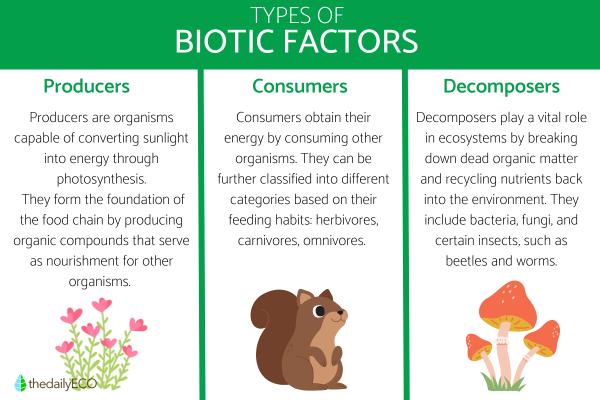
- Feeding relationships categorize organisms into producers (plants and some bacteria), consumers (organisms that consume other organisms), and decomposers (organisms that break down organic matter).
- The diverse array of species reflects the richness of life and contributes to the resilience and functionality of ecosystems.
- Evolution and natural selection drive the adaptation of organisms over time, resulting in the development of new traits and characteristics.
- Biotic factors are vital for sustaining life on Earth, providing essential resources such as food, oxygen, habitats, and ecosystem services.
In addition, the interactions among biotic factors often lead to co-evolutionary processes, where species evolve in response to each other's adaptations, enhancing their survival and ecological niches. This dynamic interaction fosters biodiversity and ecosystem resilience.
Be sure not to miss this compelling article where we delve into the concept of biological adaptation, explore its various types, and provide illustrative examples to enhance understanding.
Classification of biotic factors
Biotic factors, or living beings, can be classified in two main ways: according to ecological organization and according to their position in the trophic or food chain.
In terms of ecological organization, biotic factors can be classified as follows:
- Individual: this refers to an independent organism, either unicellular or multicellular, capable of surviving in a given environment without relying on other living beings.
- Population: a population consists of a group of individuals of the same species that share space and time. They interact with the same environmental factors and engage in activities such as feeding and reproduction.
- Community or biocenosis: a community is a collection of different populations and species that coexist in the same place or territory, known as the biotope. These communities interact with the physical environment to form distinct ecosystems.
Communities are further influenced by abiotic factors like climate and topography, which affect the distribution and abundance of species within them. Understanding these interactions can provide insights into how ecosystems respond to environmental changes.
Regarding their position in the food chain or trophic levels, biotic factors can be classified as follows:
Producers
Producers are autotrophic organisms that utilize energy from the environment, along with inorganic and mineral substances, to synthesize organic components through processes such as photosynthesis or chemosynthesis. They are the foundation of the food chain, converting energy from sunlight or chemical reactions into organic matter.
Producers not only form the base of the food chain but also contribute to the oxygenation of ecosystems through photosynthesis, supporting aerobic life forms.
Consumers
Consumers are heterotrophic organisms that rely on the organic matter produced by producers. Primary consumers, or herbivores, feed directly on producers. Secondary consumers consume other consumers, and there can be further trophic levels of consumers. These consumers transform the consumed organic matter into their own organic material, utilizing various trophic strategies such as carnivory, parasitism, omnivory, and detritivory.
Each consumer level plays a crucial role in energy transfer and maintaining the ecological balance, with predators helping control prey populations, thereby preventing overgrazing and preserving plant communities.
Decomposers
Decomposers, mostly microscopic organisms, occupy the final trophic level. They play a crucial role in recycling organic matter by breaking it down into inorganic substances, returning vital compounds to the environment. Decomposers help to complete nutrient cycles and maintain ecosystem balance.
These processes are vital for soil health and fertility, contributing to the sustainability of ecosystems by ensuring that nutrients are continuously replenished.
You might find this related article on the difference between unicellular and multicellular organisms intriguing.

The Importance of Biotic Interactions
Biotic interactions are pivotal in maintaining ecosystem stability and diversity. These interactions can be classified into different types based on the nature of the relationship between species: mutualism, commensalism, predation, competition, and parasitism. Each of these interactions plays a unique role in shaping ecological communities.
Mutualism
Mutualism is a type of interaction where both species involved benefit from the relationship. A classic example is the relationship between bees and flowering plants. Bees obtain nectar for food, while plants receive the service of pollination, which is essential for their reproduction.
Commensalism
In commensalism, one species benefits while the other is neither helped nor harmed. An example is barnacles attaching to the shell of a turtle. The barnacles gain mobility to different feeding grounds, while the turtle is unaffected.
Predation
Predation involves one organism, the predator, feeding on another organism, the prey. This interaction helps control prey populations and can drive evolutionary changes, such as adaptations in prey species to escape predation.
Understanding these interactions provides insight into the complexity and interconnectedness of ecosystems, highlighting the importance of conserving biodiversity to maintain ecological balance.

Examples of biotic factors in terrestrial ecosystems
In terrestrial ecosystems, the influence of biotic factors is profound, as they shape the environment and drive interactions among organisms. Biotic factors comprise a diverse array of living organisms, including plants, animals, microorganisms, and fungi. To gain a deeper understanding of their impact, let's explore examples of biotic factors classified according to their trophic relationships.
Producers
- Chestnut trees: produce edible nuts and provide shade in forests and parks.
- Wheat: is a cereal crop widely cultivated for its grain, which is used for making flour.
- Cacti: are succulent plants adapted to arid environments, storing water in their stems.
- Ferns: are non-flowering plants with feathery leaves, commonly found in damp and shaded areas.
- Cypress trees: are evergreen conifers with tall, slender trunks often used for ornamental purposes.
- Pine tree: are coniferous trees with needle-like leaves and produce pine cones.
- Willows: are deciduous trees or shrubs that grow near water bodies, known for their flexible branches.
- Olive tree: bear small fruits, olives, and are cultivated for their oil.
Producers in terrestrial ecosystems help stabilize soil and prevent erosion, contributing to landscape formation and providing resources for a wide array of animal species.
Primary consumers
- Butterflies: are flying insects known for their colorful wings and feed on nectar from flowers.
- Meerkats: are small mammals that live in groups and feed on insects, small vertebrates, and plants.
- Rhinoceroses: are large herbivorous mammals with a characteristic horn on their nose.
- Giraffe: are the tallest land animals and primarily feed on leaves from tall trees.
- Deer: are herbivorous mammals that graze on grass, leaves, and other plant material.
- Donkeys: are domesticated animals used for work and feed on grass and other vegetation.
- Rabbit: are small mammals that feed on grass, herbs, and leafy vegetation.
- Rodents: include animals like mice, rats, and squirrels that have front teeth specialized for gnawing and feed on various plant material.
- Sheep: are domesticated ruminant animals that graze on grass and other vegetation.
Secondary consumers
- Toads: are amphibians that consume insects and other small invertebrates.
- Cougars: are large carnivores that prey on various animals, including deer and smaller mammals.
- Jaguars: are powerful predators that hunt a variety of prey, including large mammals.
- Wolves: are social carnivores that feed on ungulates like deer and elk, as well as smaller mammals.
- Bears: are omnivorous mammals that eat a diverse diet, including plants, berries, fish, and small mammals.
- Tigers: are apex predators that hunt a wide range of ungulates and other mammals.
- Dogs: are domesticated carnivores that consume a diet primarily consisting of meat.
Secondary consumers help keep the population of primary consumers in check, preventing overconsumption of vegetation and maintaining the balance within the ecosystem.
Tertiary consumers
- Snakes: are carnivorous reptiles that prey on a variety of animals, including rodents, birds, and amphibians.
- Hawks: are birds of prey that hunt small mammals, birds, and reptiles.
- Royal owls: are large owls that primarily feed on small mammals and birds.
- Spotted hyenas: are scavengers and predators that consume a wide range of prey, including large mammals.
- Dingoes: are wild canids that feed on small to medium-sized mammals, birds, and reptiles.
- Black panthers: are melanistic leopards that hunt various prey, including mammals and birds.
Tertiary consumers are often apex predators, playing a key role in regulating the populations of other species, which helps maintain the structure and health of an ecosystem.
Decomposers
- Vultures: are scavenging birds that feed on carrion, playing an essential role in ecosystem cleanup.
- Ravens: are intelligent birds that consume carrion, small animals, insects, and plant material.
- Beetles: are diverse insects that play important roles in decomposition by feeding on dead plant and animal matter.
- Bumblebees: are pollinators that feed on nectar and collect pollen from flowers.
- Actinobacteria: are a group of bacteria that participate in decomposition processes in soil and other environments.
- Earthworms: are soil-dwelling organisms that break down organic matter, contributing to soil health and nutrient cycling.
- Common vulture: are large birds that primarily feed on carrion, playing a vital role in scavenging and maintaining ecosystem balance.
Decomposers are crucial for nutrient recycling, ensuring that the ecosystem continues to function efficiently by breaking down dead matter and returning nutrients to the soil.
Be sure not to miss our comprehensive article, where we delve into the distinctions between biomes and ecosystems.

Examples of biotic factors in aquatic ecosystems
From tiny microorganisms to large aquatic animals, the diverse range of biotic factors significantly influence the balance and functioning of these ecosystems. In this section, we explore various examples of biotic factors in aquatic ecosystems, highlighting their significance in maintaining the delicate ecological relationships within these environments.
Producers
- Phytoplankton: diatoms and dinoflagellates are microscopic photosynthetic organisms that form the basis of the aquatic food chain.
- Seagrasses: species such as Posidonia oceanica and Cymodocea nodosa are important underwater plants that provide habitats and food for various marine organisms.
- Giant kelp: Macrocystis pyrifera is a large brown seaweed found in cold, nutrient-rich waters, supporting a diverse ecosystem.
Producers in aquatic environments are vital for oxygen production and carbon fixation, supporting a wide range of marine life.
Primary consumers
- Zooplankton: small crustaceans, copepods, ctenophores, and cladocerans are examples of zooplankton that feed on phytoplankton.
- Bivalves: mussels and clams are filter-feeding organisms that consume organic matter from the water column.
- Sea cow: manatees and dugongs are herbivorous marine mammals that graze on seagrass beds.
Primary consumers in aquatic systems play a crucial role in transferring energy from producers to higher trophic levels.
Secondary consumers
- Piranha: these carnivorous fish feed on smaller aquatic animals, including other fish.
- Squid: squid are predatory cephalopods that consume various marine organisms.
- Flamingos: these birds feed on small aquatic invertebrates and algae.
- Whales: certain species of whales, such as humpback and blue whales, are filter feeders that consume vast amounts of plankton.
Secondary consumers help control the population of primary consumers, ensuring the stability of aquatic ecosystems.
Tertiary consumers
- Killer whale: also known as orcas, killer whales are apex predators that feed on other marine mammals and fish.
- Shark: various species of sharks occupy the top of the food chain, preying on a wide range of marine organisms.
- Sea crocodile: saltwater crocodiles are opportunistic predators that feed on fish, crustaceans, and other aquatic animals.
- Sperm whale: sperm whales are known to consume large quantities of squid and other deep-sea creatures.
- Sea leopard: this species of seal feeds on fish, squid, and other marine prey.
- Sea wolf: also known as the Atlantic wolffish, it is a carnivorous fish that feeds on crustaceans and other fish.
- Seals and sea lions: these marine mammals feed on fish, squid, and other prey items.
- Guitar ray: Pseudobatos productus is a bottom-dwelling ray that consumes crustaceans and small fish.
Tertiary consumers are essential for maintaining the balance of marine ecosystems by regulating the populations of prey species.
Decomposers
- Fungi and water molds: these organisms play a crucial role in breaking down organic matter in aquatic environments, recycling nutrients back into the ecosystem.
Decomposers ensure the recycling of nutrients, which is vital for the sustainability and productivity of aquatic ecosystems.
Don't miss out on this informative article where we delve into the fascinating world of aquatic ecosystems.

If you want to read similar articles to What Are Biotic Factors?, we recommend you visit our Environment (other) category.