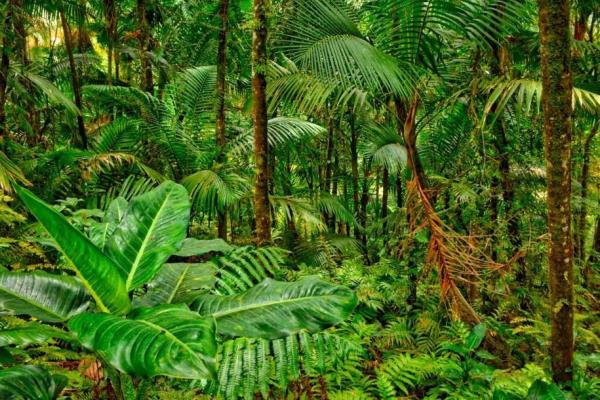
The world's rainforests store up to 50% of the CO2 that exists in our atmosphere, although this amount may be reduced thanks to climate change. The ability to absorb so much carbon dioxide is thanks to the vegetation which abounds in jungle ecosystems. It is thanks to this abundant vegetation that we can reduce the effects of air pollution worldwide. Even those of us many miles removed from the next jungle benefit from these ecosystems thanks to their ability to clean the air around us. The biodiversity of jungle ecosystems is not limited to plant life, but the animal species which live there are some of the most fascinating we can encounter.
At thedailyECO, we ask what are jungle ecosystems? To answer this question, we provide a definition of dense forest ecosystems and examples we can find across the world.
What is a jungle ecosystem?
There is some confusion about what constitutes a jungle. While we may be able to conjure quite specific images when we think of them, a more precise definition of a jungle is hard to determine. Herein lies the explanation, since jungle is not a technical scientific term. Rather, it is a descriptive term for an area with the following:
- Dense forest
- Tangled vegetation in the undergrowth
If you have ever seen a documentary or movie where people hack through vegetation with a machete, you have seen depictions of jungles. These ecosystems are full of rich plant life, which makes it difficult for humans to traverse, but they are the ideal habitats for an incredible range of biodiversity. This is the definition of jungle ecosystems, i.e., the organisms and their interactions within tangled vegetation of a dense forest.
Rainforests are some of the most densely vegetated areas on the planet. For this reason, many confuse the terms rainforest and jungle. Rainforests have dense forests and tangled vegetation, but so do other areas. To help make the distinction between jungles and rainforests, we can say that rainforests are a type of dense jungle, but not all jungles are rainforests.
In addition, jungles play a crucial role in maintaining ecological balance. They provide habitats for countless species and are vital in the global carbon cycle. Their existence is essential for the health of our planet's ecosystems.
Learn more about rainforest ecosystems by looking at our guide to the different types of forests.
Different types of jungles
Despite having the same basic characteristics which mean they are a jungle, there are different types of densely forested areas we consider jungle ecosystems. All are abundant in life, but they have some different characteristics which distinguish them from each other. For example, although they may all have abundant vegetation, different jungle ecosystems have different types of vegetation.
The following are the most common types of jungle ecosystems:
- Tropical rainforests: characterized by being the rainiest ecosystems on the planet, rainforests have an immense range of trees, plants, and vines. Although there are jungle ecosystems outside of rainforests, it is these tropical areas that are most associated with jungles.
- Omagua (low jungle): this is one of the eight natural regions in Peru known for its diverse range of flora and fauna. The vegetation in this jungle ecosystem is adapted to the presence of numerous fluvial courses, such as rivers and lagoons. Learn more with our guide to natural regions.
- Flooded and swampy forests: in these jungles, the vegetation shows different adaptations to survive and develop in flooded soils and coexist with other characteristic organisms of these ecosystems, such as amphibians.
- Monsoon forests: there is a marked rainy season in these jungle ecosystems, which is combined with a subsequent very dry season. This is why much of the vegetation that inhabits it has developed periods of latency and/or less activity to survive the dry season.
- Dry forests: as their name indicates, these forests are characterized by the extreme drought that they experience for long periods. This means they have numerous species of deciduous trees, which better support and manage the lack of water in the ecosystem. Although some dry forests contain jungles, it is true that jungle ecosystems are more closely associated with humid areas.
Now that we know the different types of jungle that exist, it is useful to also know some examples of the most striking and outstanding jungles on the planet. Many of these can be found in the Americas, particularly South America. Some examples of jungle ecosystems can be found in the following places:
- Misiones Province: tropical rainforest located between Brazil, Argentina, and Paraguay.
- Amazonia: the largest and densest jungle in the world, which covers most of the Amazon basin.
- Omagua: low jungle of Peru.
- Lacandon Jungle: rainforest with great diversity of soils and topographies.
- Guinean Forests of West Africa: an ecosystem known as a biodiversity hotspot.
- Congo Basin: contains some of the largest tropical rainforests in the world.
Although there is great biodiversity in temperate forests, they are often contrasted with jungles. Learn more by looking at the plants and animals that live in temperate forests.
In addition to these examples, it's important to recognize the cultural significance of jungles to indigenous communities who have lived in harmony with these ecosystems for centuries. Their traditional knowledge is invaluable in understanding and preserving these vital environments.

Characteristics of the jungle ecosystems
As stated above, the main qualifiers for what is a jungle ecosystem is a densely forested area with a lot of tangled vegetation. However, there are other common characteristics of jungle ecosystems which we can use in a general sense (although there may be some exceptions):
- High humidity and presence of large cumulus clouds
- Warm climate throughout the year
- Frequent or intermittent periods of heavy rainfall
- Clay soils, rich in various nutrients, such as magnesium, calcium, and humus
Among the main functions of rainforest jungles is the ecological role they play on a global scale. As well as the aforementioned ability to be a sink for CO2 and emitter of oxygen, they are natural ecosystems that protect hydrographic basins. Unfortunately, their ecological value has been lessened over the years due to pollutants, deforestation, and other factors which influence climate change. In fact, reports from 2021 suggest the Amazon now emits more CO2 than it absorbs[1].
Furthermore, these ecosystems are pivotal in regulating local and global weather patterns. They influence precipitation cycles and help in maintaining atmospheric moisture, which subsequently affects weather and climate far beyond their physical boundaries.

Flora of jungle ecosystems
Since jungle ecosystems are defined by their thick vegetation, it should be no surprise that we find the flora of jungles to be rich in variety. They are also closely adapted to the climatic conditions of jungles. This means high levels of humidity and heat (with the exception of dry forests), as well as living in tangled formations. They also have specific adaptations to disperse seeds, often with the help of animals in jungle ecosystems. Since many jungle plants live in the areas underneath rainforest canopies, they are often adapted to low levels of sunlight.
Some of the most abundant species of vegetation in jungle ecosystems are:
- Palm trees (family Arecaceae)
- Pines (family Pinnaceae)
- Lianas (woody vines)
- Ferns (class Pterophyta)
- Wild cane (Gynerium sagittatum)
- Mahoganies (family Meliaceae)
- Orchids (family Orchidaceae)
- Durian (Durio zibethinus)
- Cocoa (Theobroma cacao)
- Arrowleaf elephant ear (Xanthosoma sagittifolium)
Beyond these, jungle ecosystems are home to many medicinal plants utilized by indigenous cultures for centuries. These plants offer potential for modern medicine, emphasizing the need to preserve these ecosystems to unlock their hidden benefits.

Fauna of jungle ecosystems
The jungle hides a rich and varied biodiversity of animal species. Many of them are poisonous species or camouflage specialists. This is because many jungles are ecosystems with so much life and color, it is essential to have some type of survival strategy.
Insects, birds, elusive reptiles, and moisture-loving amphibians abound in the jungles. There are also many mammals with different adaptations to living amongst the trees and tangled vegetation of the jungle. They can use them to obtain food, either eating the fruits of many plants or hiding to catch animal prey unawares. There are numerous fish species which can be found in the rivers and lakes which are part of many jungle ecosystems.
Some of the most outstanding jungle animal species are:
- Jaguars (Panthera onca)
- Capybaras (Hydrochaeris hydrochaeris)
- Toco toucan (Ramphastos toco)
- Black caiman (Melanosuchus niger)
- Piranhas (Family Serrasalmidae)
- Golden dart frog (Phyllobates terribilis)
- Green anaconda (Eunectes murinus)
- Pale-throated sloth (Bradypus tridactylus)
- Electric eel (Electrophorus electricus)
- Blue-and-yellow macaw (Ara ararauna)
- Orange-winged amazon (Amazona amazonica)
To learn more about how plants and animals function within jungles and other ecosystems, take a look at our comparison between biotopes and biocenosis.
Additionally, many of these animals play crucial roles in seed dispersal and pollination, helping maintain the health and diversity of jungle ecosystems. Protecting these species is vital as they contribute to the intricate web of life that sustains these rich habitats.
If you want to read similar articles to What Are Jungle Ecosystems?, we recommend you visit our Ecosystems category.
1. Carrington, D. (2021). Amazon rainforest now emitting more CO2 than it absorbs. Retrieved from:
https://www.theguardian.com/environment/2021/jul/14/amazon-rainforest-now-emitting-more-co2-than-it-absorbs
- Alcaraz, F. (2012). Equatorial and tropical forests. University of Murcia, Spain.