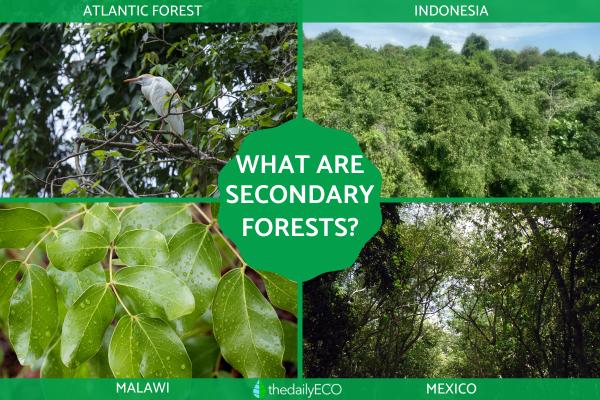
Also known as second-growth forests, secondary forests are forests regenerated from disturbances of mainly anthropic causes, but natural causes are a factor. They host a great biodiversity, from various sizes of trees and plants, as well as carnivorous mammals, birds, insects, and various animal species. These forested extensions contribute to the mitigation of climate change and provide numerous ecosystem services, among many other functions.
Forests are ecosystems characterized by a relatively continuous tree layer, whose structural complexity and diversity increase according to humidity and temperature. The components that make up forests form multiple interaction networks essential for their operation. Human beings are part of these relationships, being both the major cause of deforestation and the best hope for conservation. Learn more with thedailyECO as we ask what are secondary forests? We answer by providing a definition with examples.
What are secondary forests?
Although definitions can vary slightly, secondary forests have one main characteristic. This is the presence of a disturbance generated usually by human beings, but also by natural causes. Disturbances are an ecological term for changes in an ecosystem due to preceding changes in an environment's conditions. Natural disturbances include atmospheric or geological factors, but human disturbances have been superseding natural factors for some time.
According to CATIE (Tropical Agricultural Research and Higher Education Center), secondary forests refer to the presence of successional woody vegetation that develops on land whose original vegetation was destroyed by anthropic activities. The degree of forest recovery will depend mainly on the duration and intensity of previous land use by agricultural crops or pastures, as well as the proximity of propagule sources to recolonize the disturbed area.
Learn more about disturbances to ecosystems with our article on the different types of environmental degradation. It should be noted that these disturbances can also lead to unexpected positive ecological outcomes, such as the promotion of new species that adapt swiftly to altered conditions, thereby increasing biodiversity.

Characteristics of secondary forests
We can better know how secondary-growth forests function and affect the large environment by looking at the characteristics of secondary forests. Secondary forests:
- Contribute to the mitigation of climate change: secondary forests accumulate biomass rapidly during the first 20 to 30 years, becoming an important reservoir of atmospheric carbon.
In this regard, the carbon sequestration potential of secondary forests is significant, as they can store carbon at rates comparable to tropical primary forests. - Are reservoirs of biodiversity and promote landscape connectivity: this is because they provide refuge for numerous species, especially in those places where the habitat has been severely fragmented into isolated patches.
For example, secondary forests can serve as corridors, facilitating the movement of wildlife between habitat fragments, which is crucial for maintaining genetic diversity. - Provide numerous services for their ecosystems: some of these services are direct, such as the supply of wood, fiber, and firewood, and others are indirect through influencing ecosystem processes essential for life.
Moreover, secondary forests play a role in water cycle regulation by enhancing soil infiltration and reducing runoff. - Reduce soil erosion: by reducing the impact of strong winds.
Additionally, the root systems of secondary forest plants stabilize the soil, further preventing erosion. - Improve the quality and structure of the soil: by providing nutrient-rich organic matter.
As such, they enhance the fertility of the soil, making it more conducive to supporting diverse plant life. - Help other forests: they contribute to conserving and reducing pressure on primary forests as secondary forests can be used as transition or buffer areas. Learn more with our article on what are primary forests?
Furthermore, secondary forests can protect the edges of primary forests from external threats such as fire and invasive species. - Forest rehabilitation: they serve as models of forest rehabilitation strategies which can be applied to ecosystems all across the world.
By studying secondary forests, scientists gain insights into natural recovery processes that can inform conservation efforts globally. - Heterogeneous structure: its structure and composition are heterogeneous and vary depending on the fertility of the soil, the previous use of the land, and the existing distance to seed banks.
This variability results in unique ecological niches that support a wide range of species.
Flora and fauna of secondary forests
The composition of flora and fauna in secondary forests varies depending on geographic location, climatic conditions, and land use history in the region. However, certain generalizations can be made.
Secondary forest flora
Secondary forests regenerate through a process of secondary ecological succession in which a different community settles than the one that existed prior to the disturbance.
The species that settle sprout or germinate from propagules (structures that give rise to a new organism such as seeds or spores) that are buried in the ground. Others come from neighboring sites. This is because the access of propagules is easier due to the disappearance of the vegetation. The result is a very heterogeneous community providing a great richness and diversity of short-cycle, annual plants that have a great dispersal capacity. Said community is very ephemeral since in two or three years it is replaced by another (generally annual grasses).
Later, the perennial species with the longest cycle appear and the process ends with the regeneration of the biological community that existed before the disturbance occurred. Woody species usually settle in the early stages of the succession, but go unnoticed because they take a long time to grow and develop.
Learn more about biological communities with our guide to the difference between biotopes and biocenosis. Similarly, the regenerating flora often includes pioneer species, which are specially adapted to colonize disturbed areas and pave the way for more complex plant communities.
Fauna of secondary forests
Regarding animal species, it is common for the presence of large herbivorous mammals to be scarce in tropical or subtropical forests. It is more frequent to find arboreal species such as monkeys and herbivores that forage for food on the ground. These include tapirs, deer, and rodents, although the group of vertebrates that stands out the most are birds. See some of the biggest birds in the world with our related article.
Large carnivorous mammals are not usually abundant, but we can find species such as the jaguar in the humid forests of South America, the tiger in Asian jungles, and certain species of smaller cats. Insects inhabit different strata of secondary forests and are a group that presents a great richness and diversity of species. These insects play vital roles, such as pollination and decomposition, which help maintain the ecosystem's balance.

Examples of Secondary Forests
Now we know the definition of secondary forests, we can look at some examples of second-growth forests across the world:
- Atlantic Forest of Brazil: the Atlantic Forest of Brazil is one of the most biodiverse regions in the world, but has undergone important changes in land use due to the expansion of the agricultural and livestock frontier and urbanization. Efforts to restore these forests are currently underway, such as the Pact for the Restoration of the Atlantic Forest, a multi-stakeholder restoration project in Brazil.
Notably, this region is home to several endemic species that rely on secondary forests for survival. - Secondary Forests in Indonesia: Indonesia has experienced significant deforestation in recent decades due to the expansion of the palm oil industry and illegal logging. However, efforts are underway to restore secondary forests in areas like Sumatra and Kalimantan. The Borneo Orangutan Survival Foundation has established a sanctuary for the orangutans in an area of secondary forest in Central Kalimantan province.
Similarly, these conservation efforts not only aid wildlife but also support local communities by promoting sustainable land-use practices. - Secondary forests in Mexico: Mexico has a large amount of regenerated secondary forests in areas previously used for agriculture and livestock. In the region of Los Tuxtlas, in the state of Veracruz, a Biosphere Reserve has been established that protects a large amount of secondary forests and other ecosystems.
In addition, these forests contribute to the preservation of indigenous cultural heritage by supporting traditional land management practices. - Secondary forests in Africa: in many parts of Africa, secondary forests have regenerated such as in southern Tanzania, where the Uluguru Forest Reserve is located, which protects a large area of secondary forests and is home to a wide variety of animal and plant species.
Furthermore, these forests serve as critical habitats for endangered species and play a role in regional climate regulation.
These are just a few examples of the many secondary forests that exist in the world. These forests are essential to maintain the health of the planet and, therefore, research and work must continue on their protection and restoration.
Learn more about other woody areas with our guide to the different types of forests. It is crucial to understand that these forests not only provide ecological benefits but also offer opportunities for sustainable economic development.
If you want to read similar articles to What Are Secondary Forests? - Definition With Examples, we recommend you visit our Ecosystems category.
Smith, J., Sabogal, C., de Jong, W., & Kaimowitz, D. (1997). “Secondary forests as a resource for rural development and environmental conservation in the Latin American tropics”.