Difference Between Frogs and Toads

 Add us on Google
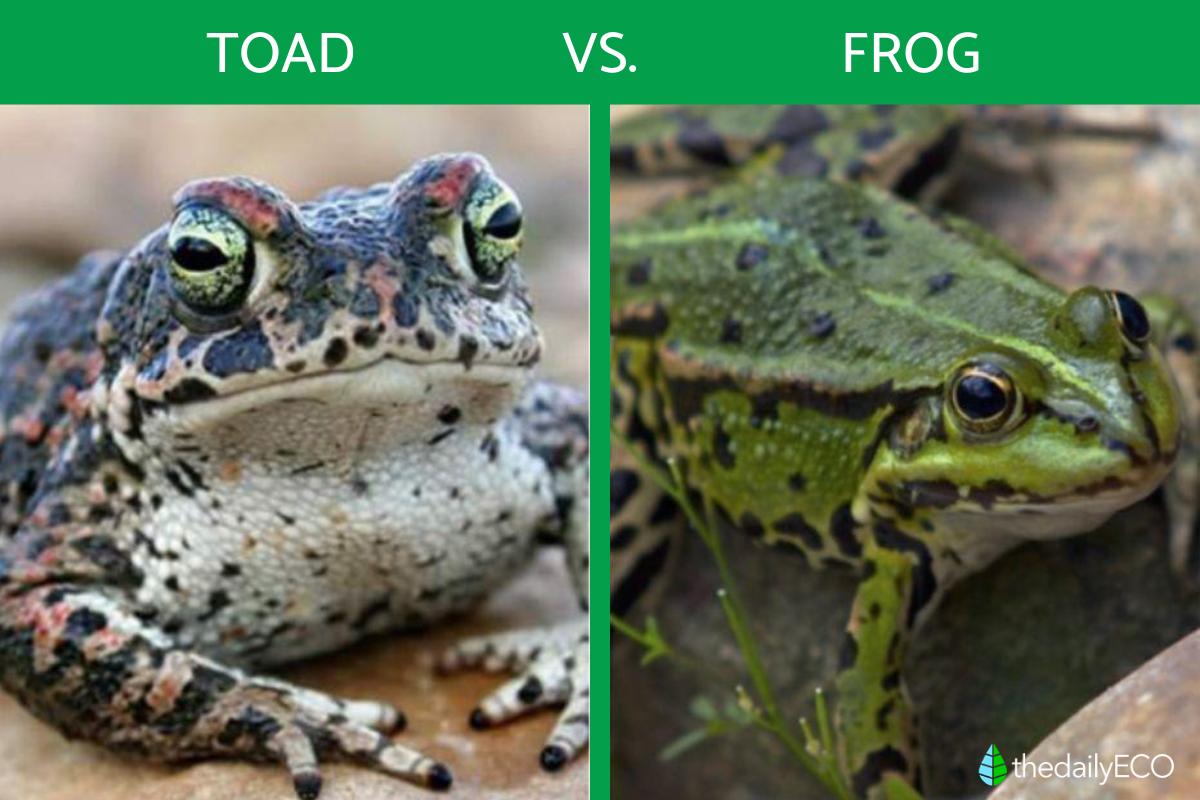
If you are walking in nature and you come across a slippery animal croaking and hopping, you may find it difficult to know if you are witnessing a toad or a frog. Both are amphibians from the order Anura. They may have bulging eyes, strong hind legs, and slimy skin, but they are also noted for their great variety. Some can be brilliantly colored with intricate patterns on their skin. Others may be drab in color and blend in easily with the foliage of their environment. Since frogs and toads have so much in common, it can make us wonder what is the difference between frogs and toads?
At thedailyECO, we answer our question by making a comparison of frog vs. toad differences and similarities. We provide photos and diagrams to illustrate these contrasts and help you to understand the characteristics of both.
What is the difference between a frog and a toad?
In biology and zoology, animals are grouped together according to taxonomic rank. By grouping species together, we can both better understand their behaviors and characteristics, as well as their contrasts with other animals. Unfortunately, this does not particularly help us with our frog vs. toad comparison.
Frogs and toads are both members of the order Anura, meaning they are technically the same animal. To look at the differences between frogs vs. toads, we need to look at characteristics other than taxonomic rank.
Since they are the same animal, frogs and toads are the same animal. The differences are not to do with animal type as they are all known scientifically as frogs. Certain characteristics mean some types of frogs are considered toads. In this way, all toads are frogs, but not all frogs are toads.
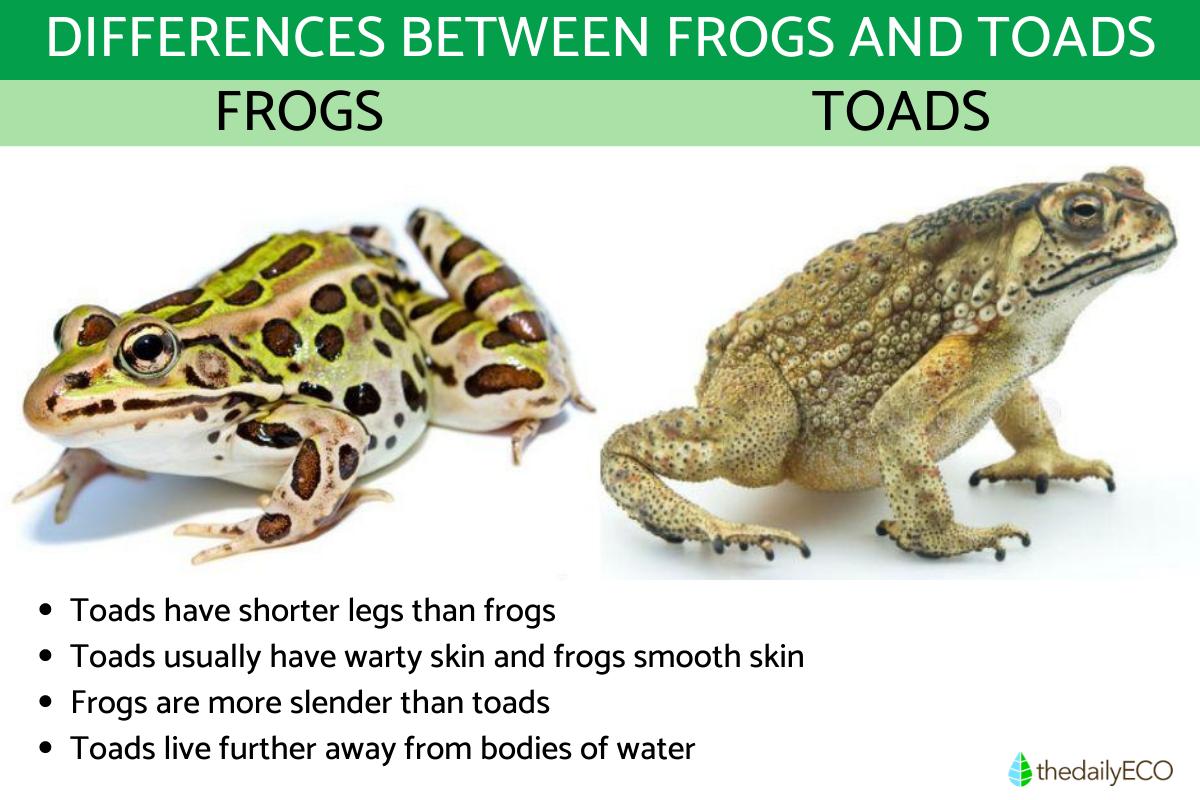
Specifically, the differences between toads and frogs can be found in the following:
- Type of skin
- Body shape
- Extremities
- Reproduction
- Movement
- Habitat
Now we can look at these similarities and differences in more detail.
The skin of toads and frogs
The skin of frogs is usually smooth and shiny, always with a wet appearance. This doesn't mean all frogs are wet to the touch. Some of them have a muculent texture thanks to a mucus secretion which helps to keep their skin moist and which aids respiration. This is because frogs can breathe through their skin, as well as their lungs.
Some frogs have a thicker and coarser skin which is often covered in wart-like growths. These features are characteristics which means they are considered toads. Toads are frogs that are particularly well-adapted to living away from water sources. A thicker skin helps them to better protect themselves.
Another way that toads can protect themselves is through poisons released via their skin. Some frogs which are not toads are poisonous in this way. However, all toads are poisonous while not all frogs are poisonous.
In addition to their skin differences, frogs typically have smoother, more vibrant skin compared to the often duller and rougher skin of toads. This distinction is crucial for their survival strategies, as the vibrant colors of some frogs can serve as a warning to predators about their toxicity.
Body and leg morphology
We may think of frogs as slender animals with agile bodies. Their legs may seem to be long and thin, with especially well-developed hind legs. In contrast, toads are much more robust and have a more forceful bearing. The body of toads is shorter and rounder than many other frog species. In comparison, many types of frogs are slender and elegant in form.
Frog legs are not just built for jumping; they play a role in swimming. Frogs are often more adept swimmers than toads, and their leg structure reflects this aquatic adaptation. Toads, however, are better suited for a life that involves more walking and less leaping.
Frog and toad reproduction
Although both families lay their eggs in the water, frogs do so by forming clouds covered with a substance that holds the eggs together. Toads lay their eggs in lines on the leaves of aquatic plants.
Moreover, the reproductive habits of frogs and toads show how each has adapted to its environment. Frogs often choose to breed in permanent bodies of water, ensuring that their offspring have a stable aquatic environment. Toads, on the other hand, can breed in more temporary water sources, reflecting their less aquatic nature.
Movement
Frogs are the best at jumping, due to their lighter weight and hind legs which are larger than those of toads. This allows them to propel themselves through the air very easily. Some frogs also have appendages on their limbs which allow them to better attach to vertical surfaces. Toads are generally less agile frogs which often tend to bury themselves underground as a better way to evade predators.
Habitat
Both frogs and toads are amphibious creatures. While frogs hardly stray far from water sources because they are more dependent on moisture, toads can live for long periods of time on land. This is because their bodies have greater control over retaining moisture.
While these are the main differences between frogs and toads, it is important to note that these are only general guidelines. Since all toads are frogs, there is some overlap in certain species. For example, there may be a species considered a frog which is stockier than others, but it is not necessarily considered a toad. Only a herpetologist (someone who studies amphibians and reptiles) will often be able to differentiate them with complete certainty.
There are many animals which appear to be very similar, but are actually different species. Learn about some others with our article on the differences between crocodiles and alligators.

Similarities between frogs and toads
Now we know the differences between toads vs. frogs, we should know there are many similarities. This is not surprising when we consider the fact they are the same type of animal. Specifically, the similarities between toads and all other frogs include:
- Both are anuran amphibians
- They both lay eggs
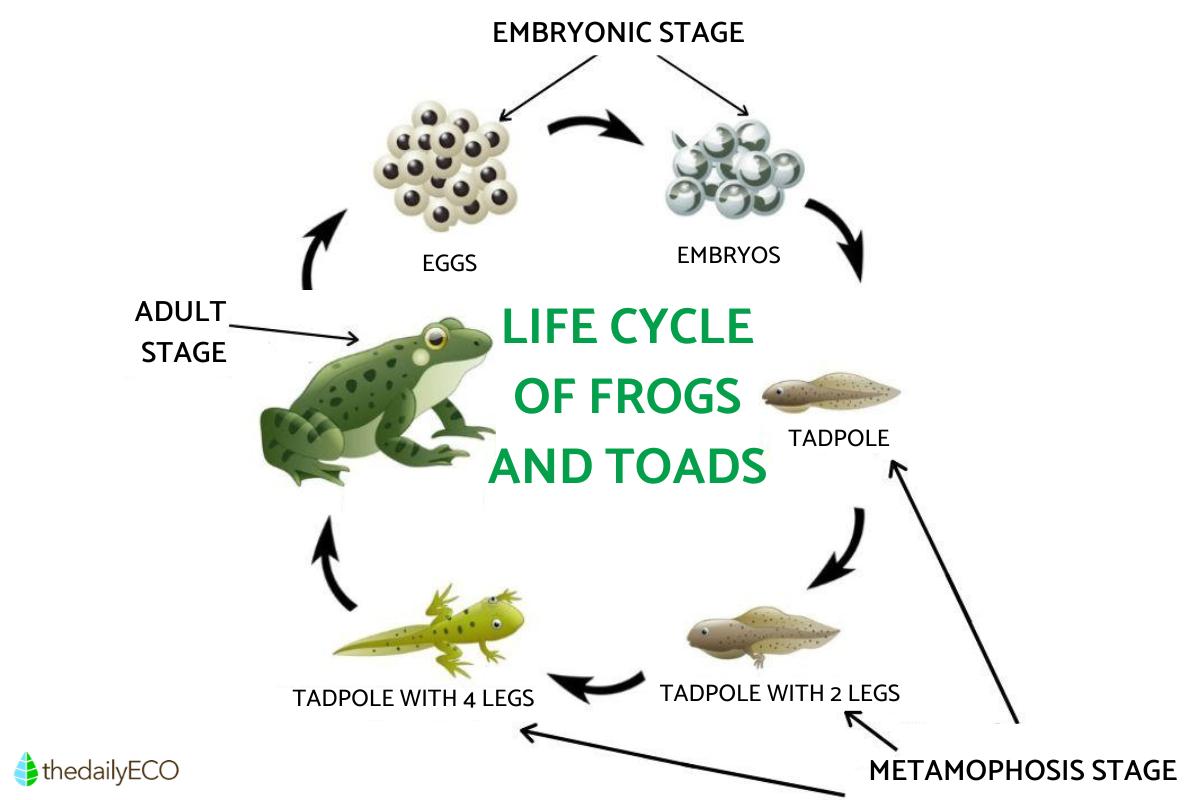
- Their life cycle shares the metamorphosis from tadpole to adult
- They need moisture
- They breathe through the skin
In addition to these frog and toad similarities, they both have gills when they are tadpoles. This does not mean that frogs and toads breathe only through their skin when they are adults. They both will use a combination of skin and lung respiration.
Despite having certain differences in reproductive behavior, toads and other types of frog have an almost identical life cycle. They both hatch as tadpoles which are aquatic and breathe through gills. As they grow and develop they will lose their tails, develop their lungs and develop terrestrial habits in addition to aquatic behaviors.
Despite the fact toads will often live further away from bodies of water than other frogs, all frogs need moisture for survival. A humid environment is particularly important for toads when it comes time for reproduction.
Furthermore, both frogs and toads are ectothermic, meaning their body temperature is regulated by the surrounding environment. This trait is common among amphibians and plays a crucial role in how they interact with their habitats, influencing their activity patterns and behavior.

Characteristics of toads
While the order Anura, we can find certain subcategories known as families. These are types of frog which share certain characteristics. One such family is Bufonidae. This is a group of frogs known as true toads. The main characteristics of true toads are:
- They are more detached from the aquatic environment
- Their skin is thick and rough and usually has a warty appearance
- They inhabit muddy areas where they can dig small holes
- Some of them have spurs on their hind legs to aid digging
- They don't have teeth
- Behind the head are located the parotoid glands which produce a bad odor and their poison secretion
Additionally, true toads have adapted to a wide range of environments, showcasing remarkable resilience and adaptability. Their ability to thrive in various habitats, from arid regions to temperate forests, highlights their evolutionary success.
Characteristics of other frogs
Just as there are true toads, there is a family called Ranidae which is known as true frogs. These have the widest distribution of any frog family and generally adhere to the characteristics of non-toad frogs. However, this does not mean they do not have some overlap such as warty skin and drab colors. In general, characteristics of true frogs include:
- They have webbed fingers, with interdigital membranes (between the fingers), due to their greater adaptation to the aquatic environment
- Their legs are also strong and skillful
- They can jump and also climb stones, plants and trees with agility
- Although it is not as common as in toads, some frogs are very poisonous, their venom being much more deadly than that of true toads
Moreover, true frogs are often found in a variety of environments, from tropical rainforests to temperate woodlands. This diverse distribution is a testament to their adaptability and the evolutionary advantages of their physical traits.

Are toads bigger than frogs?
Toads are generally much larger, stockier, and heavier species. In fact, there are large toads that can feed on small rodents or snakes. Giant toads weighing almost 3 kg (6.6 lb) have been recorded. Generally speaking, we can say that toads are bigger than frogs. As stated above, this depends on the specific species but it depends on the specific species that we are comparing. There are some true frogs which may be bigger than certain toad species.
Additionally, the size difference between frogs and toads can also be linked to their dietary preferences. Larger toads often have a broader diet, consuming a variety of prey that smaller frogs might not be able to tackle.

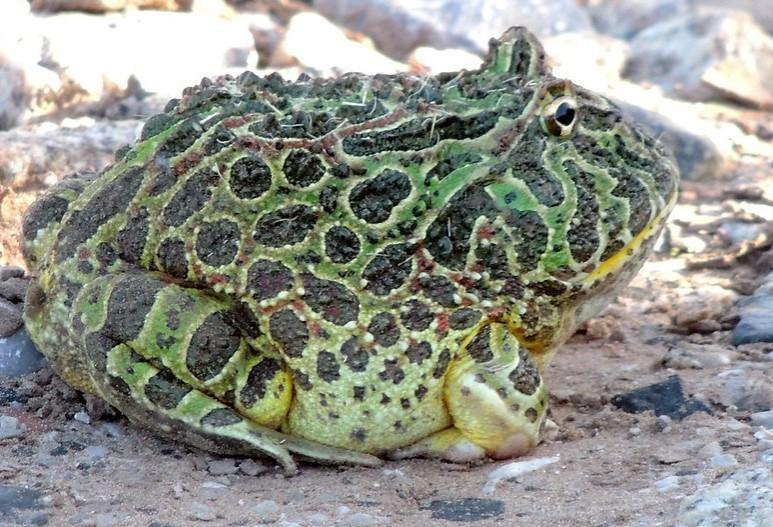
Argentine horned frog
Known scientifically as Ceratophrys ornata, the Argentine horned frog is an anuran of the genus Ceratophrys. To the inexperienced eye, it can appear that an inexperienced eye can easily confuse with a frog or a toad. This is partly due to it being variously called an ornate horned frog or an ornate pacman toad. They are highly aggressive species, with fangs and carnivorous feeding. They are found in the tropical zone of South America and measure between 12-17 cm.
The reason we highlight this species is to show how difficult it can be to see the differences between frogs and toads. They are more general than specific and are quite dependent on history, region and even folklore.
In addition to their physical characteristics, Argentine horned frogs are notable for their distinctive call, which can often be heard echoing through their native habitats. This auditory feature is another layer of complexity when distinguishing between similar species.
If you want to read similar articles to Difference Between Frogs and Toads, we recommend you visit our Facts about animals category.